
1. Send the document
Send a legible copy and indicate the language, country, receiving authority and deadline.
Support for documents to be submitted to public bodies, authorities or institutions, with attention to intended use and required formalities.
Portuguese is TraDulci’s main area of specialization. The service is handled directly by a native professional with specific experience in Italian–Portuguese translation and in official, legal and business documentation.
TraDulci provides sworn and certified translations with the same professional care not only in Portuguese but also to and from Spanish and French. Depending on the destination country and authority, any need for legalisation or an Apostille is also assessed so the client can follow the appropriate formalities for the document.
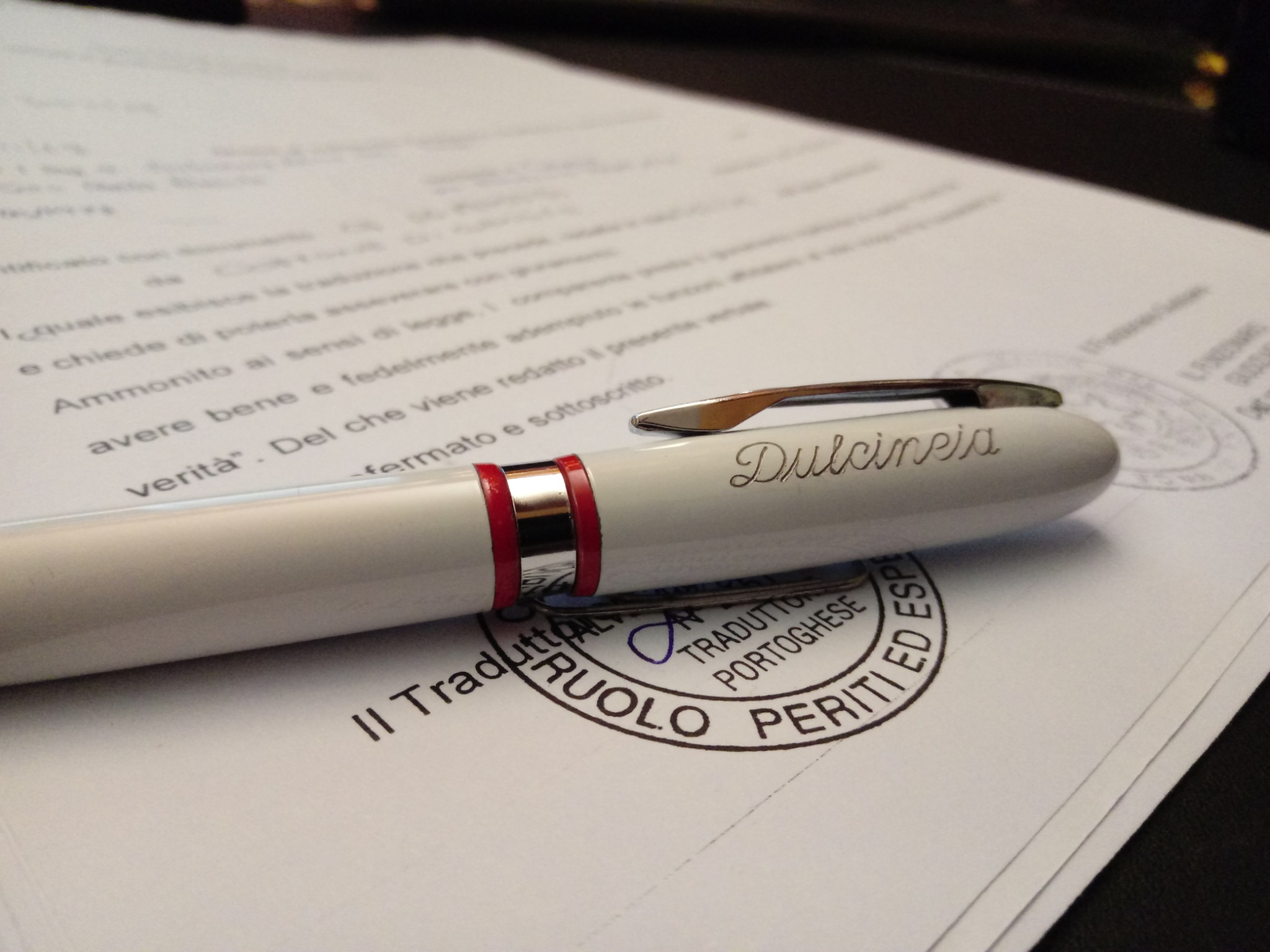
A sworn translation is accompanied by a sworn statement certifying that the translation faithfully reflects the document presented.
The required procedure may vary depending on the document, the receiving authority and the country where it will be used.
Check your documentA clear process, with prior verification of the formalities required according to the document and its destination.
Send a legible copy and indicate the language, country, receiving authority and deadline.
Translation, sworn translation and any additional formalities are assessed, with timing and cost indicated.
After confirmation, the document is translated and the process is followed through to delivery according to the agreed arrangements.
Birth certificate, Marriage certificate, Divorce certificate, Residence certificate, Proof-of-life certificate, Driving licence.
Pending charges certificate, Criminal record certificate, Judgments, Appeals, Deeds and other legal acts, Powers of attorney.
Attestations and certificates, Self-certifications.
Contracts, Company incorporation documents, Company-register extracts.
Academic qualifications (degree diploma, study programmes, certificates, specialisation, etc.).
When a document issued in Italy is to be used abroad, its authenticity may need to be verified through legalisation or, in countries party to the Hague Convention, by means of an Apostille. Legalisation officially certifies the capacity of the person who signed the document and the authenticity of the signature. An Apostille is a simplified certificate issued by the competent authority which, between Convention countries, replaces consular legalisation and allows the public document to be recognised in the destination country. The required procedure depends on the type of document, the issuing authority and the country where it will be submitted.

Not necessarily. The terminology and required legal value depend on the authority and destination country. It is best to check the specific requirement before proceeding.
No. It depends on the type of document, its origin and the destination country.
Yes. A legible copy and informationabout the intended use are normally enough for an initial assessment.

Notarial deeds, powers of attorney, records and other official documents require particular care with terminology, form and any subsequent formalities. It is useful to specify the destination country and receiving authority from the outset.
Describe the document and where it will be used: you will receive guidance on how to proceed.
